
For homecare providers in the UK
Strength training at home
Delivered by your own care workers during their visits. A twelve-week strength and balance programme for older people, guided by a tablet.
Used in Denmark, Norway, Sweden, Germany and the Netherlands. In the UK since 2023.
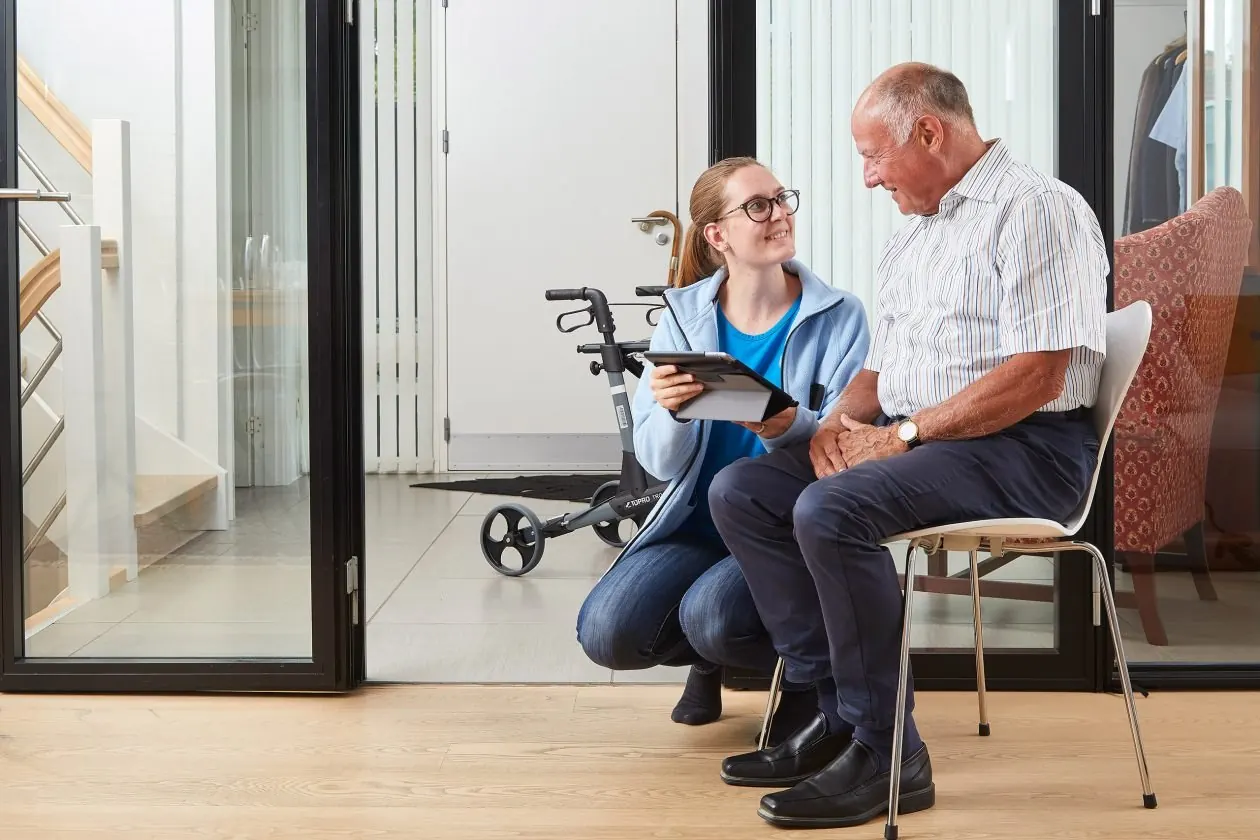
Used in Denmark, Norway, Sweden, Germany and the Netherlands. In the UK since 2023.
Nearly half
of Denmark’s 98 municipalities use DigiRehab
45+ municipalities, 2026
25,000+
programmes completed, mainly in Danish municipalities
As of 2026
25 h
less care per person in the year after starting
121 clients, one Dutch care group. Up to 78 h against each client’s own rising trend.
Affiliate member of the Homecare Association · Developed in Denmark, used in five European countries, in the UK since 2023
Evidence report, version 1.0, October 2026 · Read the evidence

Two programmes
ACTIVE
Self-funding clients and the start of a new care package
Build strength before needs settle into a pattern, and offer a service your clients can buy.
REHAB
Clients whose needs are rising
Reduce dependency and free up hours your workforce can give to the next client.
Twelve weeks
Screen
Ten standardised tests, including the 30-second chair stand, the Timed Up and Go and a four-metre walk.
Train
An individual programme, twice a week for twelve weeks, 20 to 30 minutes a session.
Review
Re-screening every four weeks; afterwards a maintenance programme with fewer visits.
Delivered within the visits a care worker already makes. In the UK, delivery is overseen by a physiotherapist. How it works

Practice in Denmark
DigiRehab was developed in Denmark and spread through practice. Nearly half of the country’s 98 municipalities use it in their homecare services. Municipalities judge it on their own care records, every year. What they see is that people manage more for themselves, and that staff time and money are saved. Those results are the reason they continue, and the reason few separate trials have been done.
45+ of 98 Danish municipalities use DigiRehab. Each square is one municipality.
Source: digirehab.dk, October 2026.
Source: annual effect reports on municipal care records since 2021.
Results in the Netherlands
In 301 Dutch clients with a first and last screening, around seven in ten improved on standard tests of walking speed, standing up and getting up and going.
In one Dutch care group, 121 clients who completed received on average 25 fewer hours of care in the 52 weeks after starting. Measured against each client’s own rising trend, the difference is 78 hours.
DigiRehab Netherlands, effect data 2022–2026, and DigiRehab, Effect of home-based training on care use, 2026. Dutch organisations are not named.
Measuring a pilot
- Agree the rules before the first client starts.
- Use your own care records, 52 weeks before and after.
- Report at three levels, the cautious figure first.
Limitations. There is no randomised trial of DigiRehab yet, and no outcome data from the UK. All results come from routine practice. DigiRehab is not a medical device and is not presented as falls prevention. Limitations and declarations
Events
Tech Innovation in Homecare Conference
19 November 2026 · One Birdcage Walk, Westminster. We show the screening, the training and the analytics at the stand.
Book a demo
See DigiRehab in action
Book a 30-minute demonstration with our UK team. We show the screening, the training and the analytics, and talk through how a pilot is measured on your own care records.
Arend Roos · UK Lead, Director of DigiRehab UK · arend@digirehab.uk · +31 6 53 27 91 89